AI is moving healthcare from reactive to proactive, wearables like Oura and WHOOP are filling the gaps between doctor visits, and everyone agrees costs have to come down. There’s still very little proof that AI is lowering those costs yet, and the smartest people in the room said so out loud at HLTH 2026. All this and more, straight from QD’s Chief Client Officer Kate Dalbey.
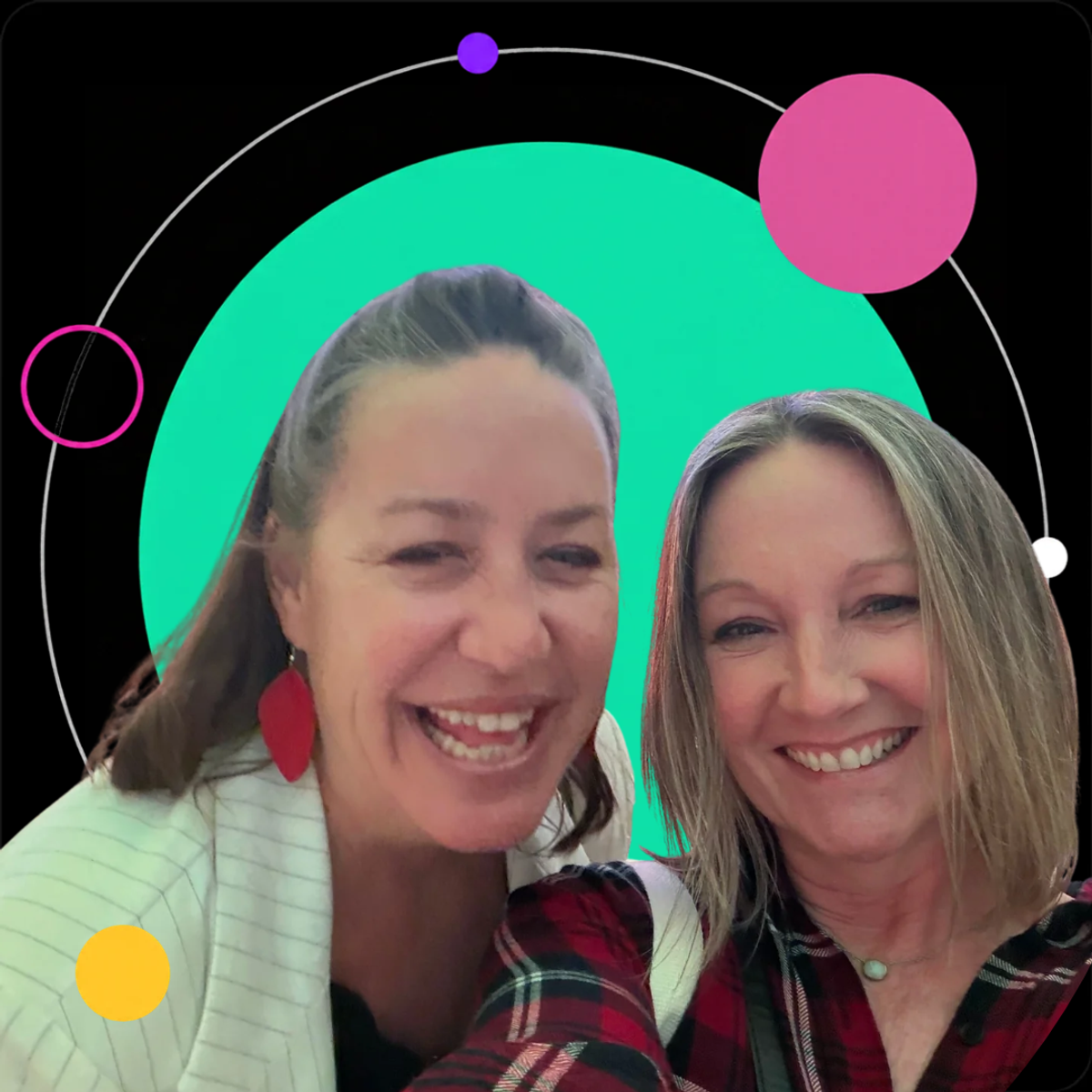
📸 Pictured: QD’s Kate Dalbey, Chief Client Officer and Joy Kuhl, Chief Growth Officer onsite at HLTH.
—
Just got back from HLTH in Vegas, and boy oh boy, am I buzzing. There’s something about the backdrop of the intense and delightful Vegas Sphere meeting the energy of leaders across all aspects of healthcare that really gets me jazzed. Where else can you find tech partners, providers, payors, and life sciences gurus all rubbing elbows with...DJs and Olympic athletes?
The conference itself felt like one big networking party, where the stages were mixed in with the vendor “floor,” and the energy didn’t really leave the space. Topics covered were broad and meaningful - from Mainstage sessions with Arianna Huffington, OpenAI, Peloton and AARP, Oura, and Dr. Oz and Amy Gleason (the first Chief Product Officer of CMS).
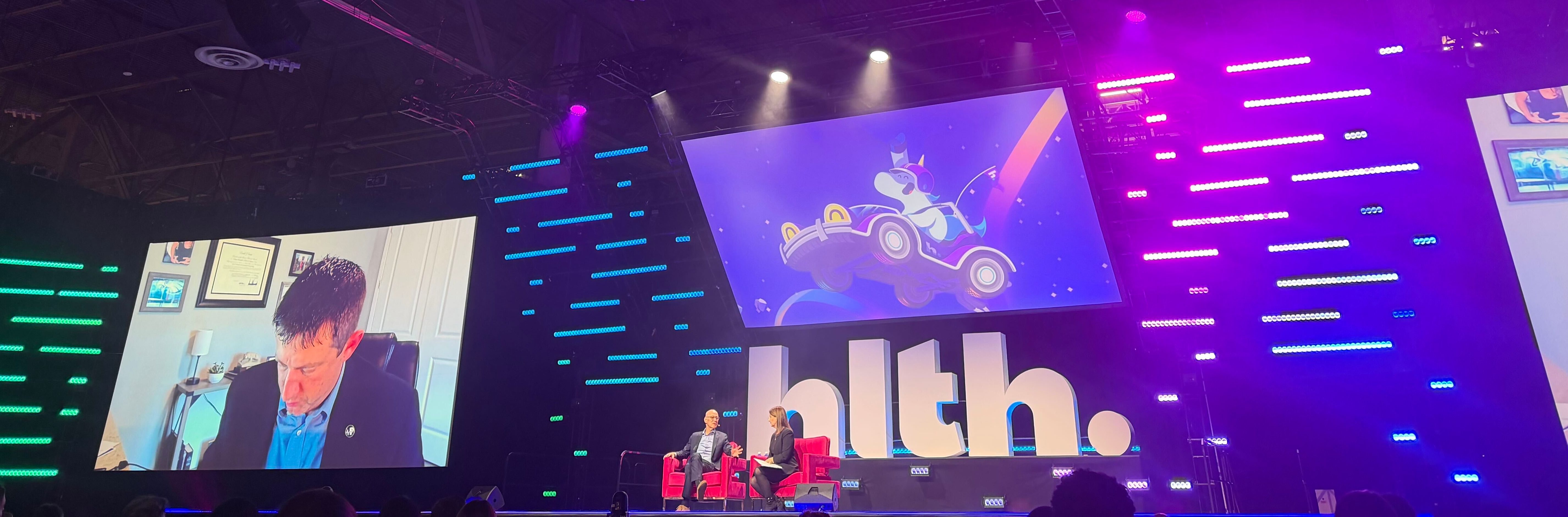

Greatness is just a bunch of small things, done well, stacked on top of each other.”
— Michael Phelps, Olympian, at HLTH 2026
Innovative, Engaging Speakers: Conversations About AI and Proactive Care
There was a “healthy” health policy debate between Brian Blase of Paragon Health Institute and Zeke Emanuel (University of Pennsylvania prof and Affordable Care Act Architect, amongst many other things), an energetic discussion of the importance of brain health and its connection to oral health by QD’s client PDS Health CEO Steve Thorne and DJ and health champion (Who knew?! Now I do!) Steve Aoki, and an inspirational deep dive on wearable WHOOP from their CEO Will Ahmed and its best and biggest fan - Michael Phelps. Thorne’s line that "saliva is the new blood” is still rattling around in my head.
Arianna Huffington’s reminder stuck with me, too. She said that “our health journey has to be a judgment-free zone.” In the AARP and Peloton session, Peloton CEO Peter Stern shared that their 50+ members are their most active, logging 45% more workouts than members under 50. How amazing is it that people in their 60s are the single most active group? If your healthcare marketing strategy assumes older consumers are less engaged, it might be time to rethink that.
One mainstage session resonated with lots of people by opening up with the viral “Sister” SNL skit. Four powerhouse women then talked through the importance of taking care of the caregiver - and why that hidden labor tends to fall on women. It rang true for a lot of us, and it’s a great example of how “of the moment” HLTH is.
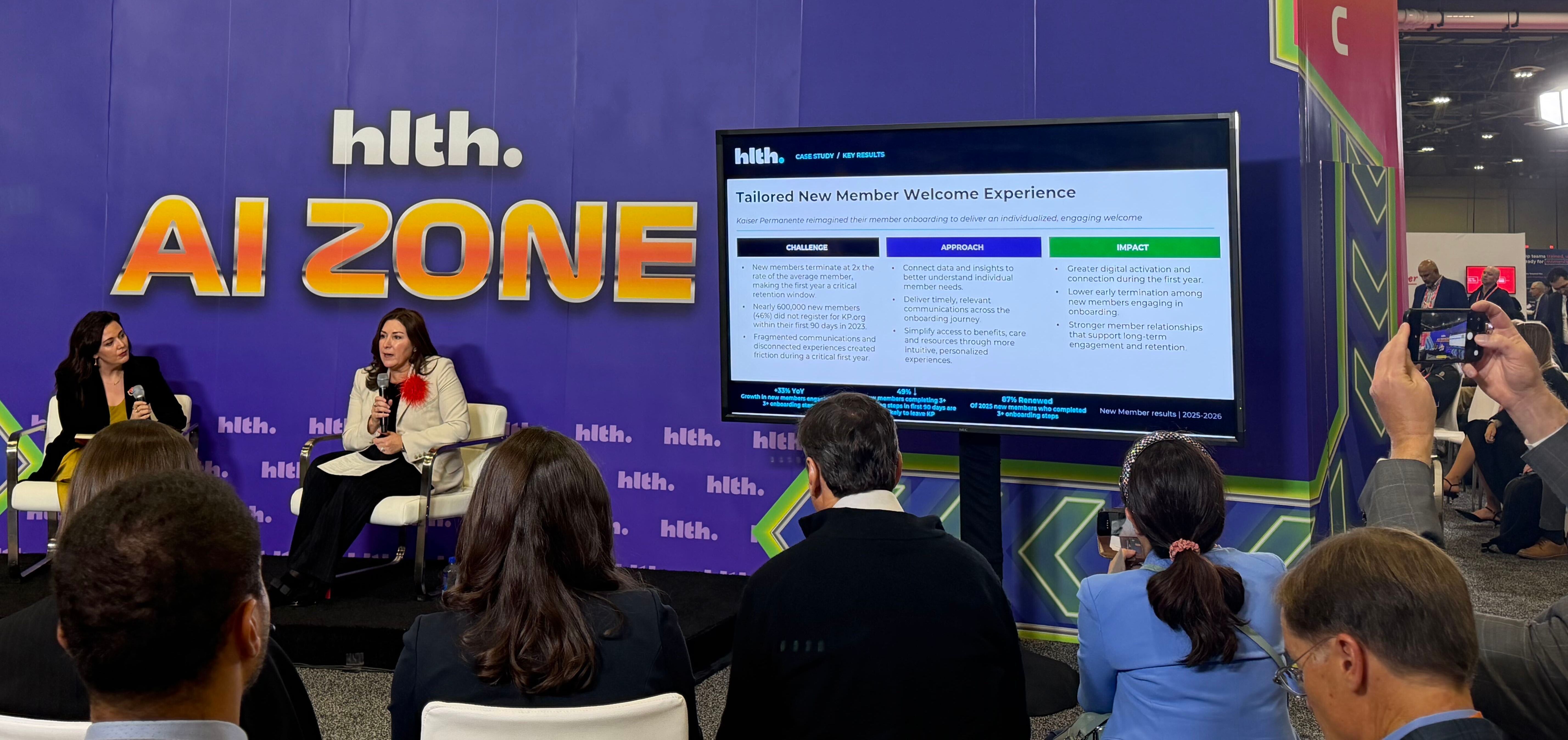
In between these mainstage sessions, the smaller stages held equally informative, intimate talks. We got a chance to hear from our client, CMO of Kaiser Permanente Kristy LoRusso, and Amy Lynn LeDuc, Head of Healthcare and Life Sciences at Adobe, discuss QD’s work supporting Member retention in KP’s New Member Experience, and the impressive ways KP is using AI to inform valuable member insights - saving 2,600 hours of time in doing so.
What were the biggest themes at HLTH 2026?
Overall, there were a few themes that came up in these sessions and in the conversations throughout the conference.
— — —
How is AI moving healthcare from reactive to proactive?
AI will help move us, as a society, from reactive to proactive participants in our health. Example: Per OpenAI leaders on stage, 300 million people use ChatGPT weekly for health queries alone (OpenAI’s own January 2026 report put that number at about 200 million, so it’s climbing FAST). I’m still having trouble contemplating that number! Scary as that is, we can't ignore that it signifies a massive behavior change in the digital space that marketers will no doubt want to be part of.
The OpenAI team said the real benefit is AI that looks at your health over time and supports physicians between visits. Patients are even saying it in the exam room now: “Doc, I really want you to be able to use AI.” Payors are moving, too - Cigna uses ChatGPT workflows to help navigate its advocacy channels.
— —
What role will wearables play in preventative care?
Wearables are key to proactiveness in that they provide continuous data to supplement the point-in-time data through traditional healthcare tools like EHRs. Oura’s Tom Hale and Counsel Health’s Muthu Alagappan said EHR data is a snapshot, usually taken when something is already wrong. They said changing behavior is the hardest part (with it taking multiple touch points to get there). WHOOP is betting on that, too. Will Ahmed shared a partnership with CMS to get WHOOP to seniors for free in exchange for advancing health outcomes, plus a partnership with Novo Nordisk.
Theoretically, wearables could “see” something earlier than point-in-time tests/data could - preventing acute incidents and/or encouraging behavior change so that chronic diseases never happen in the first place. Are we a long way off from that? I don’t know, but I will definitely keep thinking about it.
— —
Is AI actually lowering healthcare costs?
Healthcare costs are atrocious and must be managed. There’s a general consensus that AI will have a role in that but there weren’t many case studies, yet, on how it already has. One of the most candid panels (my favorite kind!) of the week asked that question directly. Maria Ansari, CEO of The Permanente Federation, said AI will optimize the system we’re in and bring costs down long term, and was also refreshingly honest, saying, “data hasn’t shown that we’re driving value yet.” Shaun Miller of Cedars-Sinai expects costs to rise in the short term before they come down. And in the policy debate, Zeke Emanuel noted we spend about $4,000 per American on admin tasks, which feels like a natural place for AI to help (I agree).
It’s clear that many organizations are getting there, though, which is inspiring to see. Will wearables also have a role in that? It will be interesting to “track” that (see what I did there?) as adoption into the care lifecycle continues.
— —
What does this mean for healthcare marketers?
Your members and patients are already asking AI about their health, and plenty of them wear a device that likely knows more about their week than what notes were captured at their last appointment. I firmly believe that organizations that pull ahead in AI will be the ones that turn those signals into connected experiences that feel personal and timely– the way KP is doing that with its new member journey.
— — —
Connected data, content that shows up where people are asking, internal teams set up to act on what they learn. Ahhhh, that’s the kind of work QD loves doing with our clients, and it was so great hearing such incredible speakers shout it from the rooftops at HLTH.
What else did you see at HLTH? Hit me up on LinkedIn to chat more - I’m always down for healthcare innovation conversation.